
Moving abroad does not take you out of the UK tax system. A UK tax advisor for expats works out your residence status, tells you which UK income stays taxable, and files the right returns with HMRC so you never pay twice or miss a deadline.
Many people assume a new address overseas ends their UK tax duties. In reality, rent from a UK flat, a UK pension or a property sale can all still create a tax bill. The rules also change in the year you leave and the year you come back.
We explains how UK tax works for expats in plain English. It also shows when expert help saves you money and stress.
What Does a UK Tax Advisor for Expats Do?
A UK tax advisor for expats specialises in the tax position of people who live, work or invest across borders. Their job is to give you a clear answer on what you owe the UK, and then keep you compliant each year.
In practice, that work usually covers:
- Confirming your UK residence status under the Statutory Residence Test
- Claiming split year treatment in the year you leave or arrive
- Reporting UK rental income and registering under the Non-Resident Landlord Scheme
- Filing the 60-day return when you sell UK property
- Claiming relief under a double taxation agreement
- Preparing your Self Assessment tax return with the residence pages
- Planning for inheritance tax and your eventual return to the UK
Our team handles all of these through our residence, domicile and double tax relief service.
Do You Still Pay UK Tax After Moving Abroad?
Yes, in many cases you do. The UK taxes non-residents on income that comes from a UK source. So leaving the country only removes your overseas income from UK tax, not your UK income.
Typical UK income that stays taxable includes:
- Rent from UK property
- Pay for work you carry out in the UK
- Most UK pensions, unless a tax treaty says otherwise
- Profits from a business you run in the UK
- Gains on UK land and property
On the other hand, a non-resident does not usually pay UK tax on salary earned abroad or on foreign investment income. That is why your residence status matters so much. It decides whether the UK can tax your worldwide income or only your UK income.
You also need to tell HMRC when you leave. If you don’t file a Self Assessment return, you normally use form P85. GOV.UK explains the steps on its page about tax if you leave the UK to live abroad.
The Statutory Residence Test Explained Simply
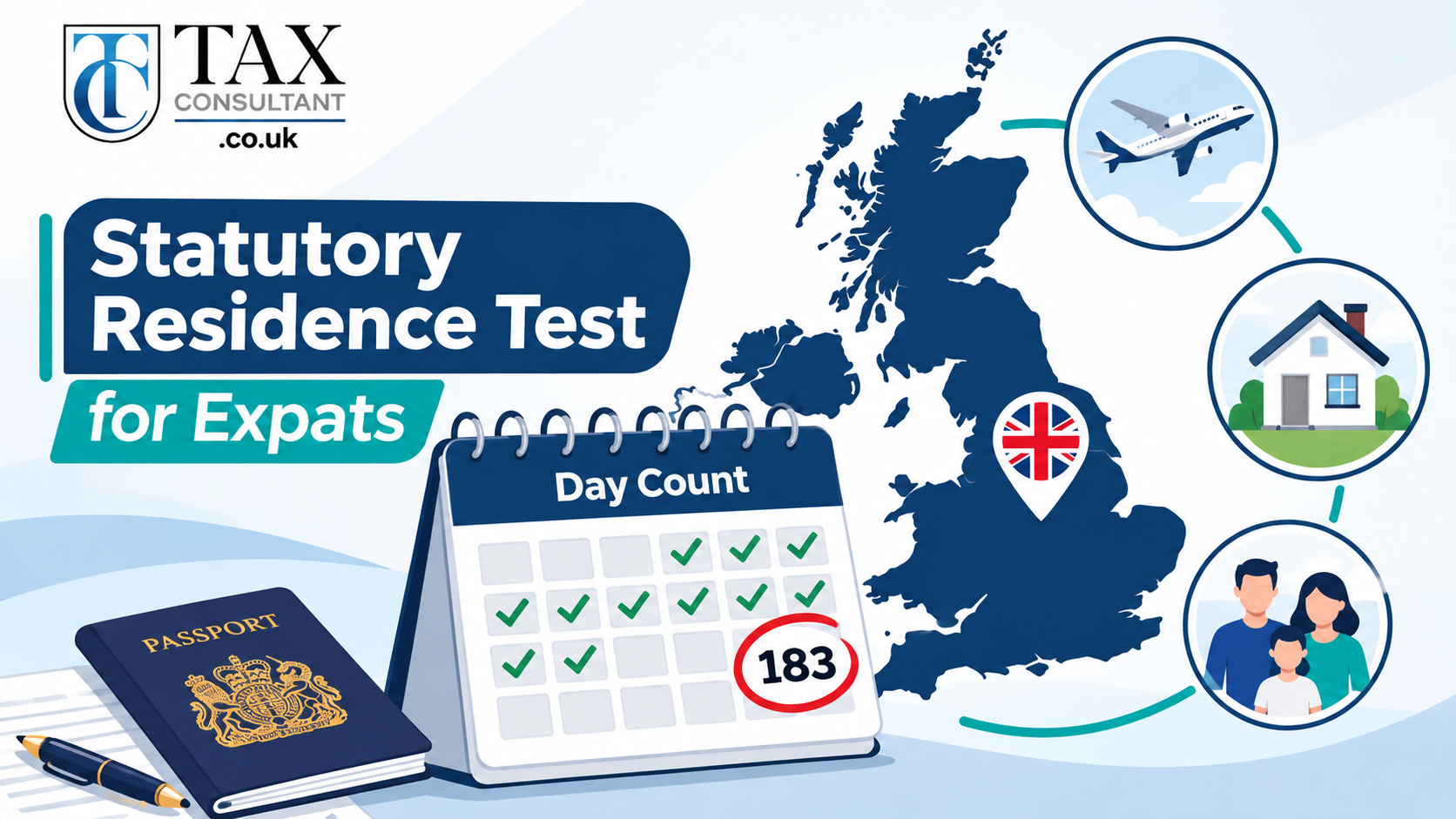
The Statutory Residence Test, or SRT, decides whether you are UK resident for a tax year. The UK tax year runs from 6 April to 5 April. The test looks at the days you spend in the UK, your ties to the country and your history.
It works in three stages.
Stage one: the automatic overseas tests
You are automatically non-resident if any of these apply:
- You were UK resident in one or more of the last three tax years and spend fewer than 16 days in the UK
- You were non-resident in all of the last three tax years and spend fewer than 46 days in the UK
- You work full time abroad, spend fewer than 91 days in the UK and work in the UK on fewer than 31 days
Stage two: the automatic UK tests
If no overseas test applies, you are automatically resident if, for example, you spend 183 days or more in the UK. You can also become resident if your only home is in the UK or you work full time in the UK.
Stage three: the sufficient ties test
Most expats land here. This test counts your UK ties and compares them with your days in the UK. The ties are:
- A family tie, such as a spouse or young children who live in the UK
- An accommodation tie, meaning a UK home you can use
- A work tie, meaning 40 or more days of UK work
- A 90-day tie, meaning you spent over 90 days in the UK in either of the last two years
- A country tie, which only applies to people who are leaving
The more ties you have, the fewer days you can spend in the UK before you become resident. As a result, one extra visit can change your whole tax position.
HMRC publishes the full rules in its RDR3 Statutory Residence Test guidance. However, it runs to over 100 pages, so most people prefer a clear written opinion from a specialist.
Split Year Treatment in the Year You Move
Under the SRT you are resident or non-resident for the whole tax year. That would be unfair in the year you leave. So split year treatment can divide that year into a UK part and an overseas part.
During the overseas part, the UK treats you as non-resident for most income. This means your foreign salary after you leave can fall outside UK tax.
There are eight cases that allow split year treatment. Common examples include starting full-time work abroad, joining a partner who works abroad, or leaving the UK to make a new home overseas. Each case has strict conditions, and you claim it on the residence pages of your tax return.
For employees sent abroad by their company, our international mobile employees service covers payroll and split year claims together.
Renting Out UK Property While You Live Abroad

Rental income from UK property stays taxable in the UK wherever you live. HMRC collects this tax through the Non-Resident Landlord Scheme.
Under the scheme, your letting agent must deduct basic rate tax from your rent before they pay you. If you have no agent, a tenant who pays over £100 a week must do it instead. GOV.UK sets out these duties on its page about paying tax on rent to landlords abroad.
The good news is that you can apply to receive your rent with no tax taken off. You do this with form NRL1. Once HMRC approves it, you report the rent on your yearly Self Assessment return and pay any tax due then.
This matters because the tax held back is often far higher than the tax you actually owe. After allowable costs and your personal allowance, many expat landlords owe much less. Some owe nothing at all.
Can expats claim the personal allowance?
Many can. British citizens and EEA nationals usually keep the UK personal allowance against UK income. People living in some treaty countries can also claim it. You make this claim through your tax return.
Selling UK Property When You Are Non-Resident
Non-residents pay Capital Gains Tax on UK property. This has applied to UK homes since April 2015 and to all UK land and property since April 2019.
The key rule is the 60-day deadline. As a non-resident, you must report every sale of UK property to HMRC within 60 days of completion. You must do this even if you made a loss or owe no tax. Missing the deadline leads to penalties and interest.
There are also choices about how to work out the gain. For example, you may be able to use the property’s value on the date the non-resident rules began. A good expat tax advisor UK clients trust will compare each method and use the one that gives the lowest gain.
You can read more about how we handle overseas gains on our overseas income and gains page.
How Double Taxation Agreements Protect You
It is possible for two countries to tax the same income. For example, the UK may tax your rent because the property is in the UK. Meanwhile, your new country may tax it because you live there.
Double taxation agreements stop you paying full tax twice. The UK has treaties with more than 130 countries. Each treaty decides which country has the first right to tax each type of income. The other country then gives a credit or an exemption.
Some common outcomes look like this:
- Rent from UK property is usually taxed in the UK first
- Salary for work done abroad is usually taxed where you work
- Government pensions are often taxed only in the UK
- Private pensions are often taxed only where you live
However, relief is not automatic. You often have to claim it on your return or apply to HMRC in advance. GOV.UK explains how to claim relief on foreign income when two countries tax it.
Moving Back to the UK
Coming home brings its own tax rules. You usually become UK resident again from the day you arrive, so timing is important.
The Foreign Income and Gains regime
From 6 April 2025, the Foreign Income and Gains regime replaced the old remittance basis. If you have been non-resident for at least ten tax years in a row, you can claim a four-year exemption on foreign income and gains.
During those four years, foreign income and gains are free of UK tax, even if you bring the money into the UK. However, you lose your personal allowance and your Capital Gains Tax annual exempt amount for any year you claim. So the claim does not suit everyone.
The temporary non-residence rule
If you return to the UK within five years, some gains you made while abroad can become taxable in the year you come back. This mainly affects assets you already owned when you left. Certain income, such as some dividends from close companies, can be caught too.
Because of this rule, it pays to plan any large sale before you leave. Our tax planning team can map out the timing for you.
Inheritance Tax for Expats
Inheritance tax now depends on residence rather than domicile. Under the rules in force from 6 April 2025, you are a long-term resident if you were UK resident for at least 10 of the previous 20 tax years.
Long-term residents face UK inheritance tax on their worldwide assets. Moreover, that exposure does not end the day you leave. It can continue for between three and ten years after you become non-resident, depending on how long you lived in the UK.
UK assets, especially UK property, stay within UK inheritance tax whatever your status. For a deeper look, read our inheritance tax advisor UK guide or see our trusts and inheritance tax service.
Self Assessment for Expats
Many expats must still file a UK tax return. You usually need one if you have UK rental income, sell UK property, claim split year treatment, or want a refund of overpaid tax.
Your return includes the SA109 residence pages. These pages are where you state your residence status and make claims such as split year treatment or the personal allowance.
The main deadlines are:
- 5 October to register for Self Assessment after the tax year ends
- 31 October to file a paper return
- 31 January to file online and pay any tax owed
A late return triggers an automatic £100 penalty, even when no tax is due. Further penalties follow after three, six and twelve months. GOV.UK lists the full Self Assessment deadlines.
If you still have links to the North West, our self assessment tax return Manchester team prepares returns for clients in the UK and overseas, including those with residence pages and foreign income.
Owe HMRC money from past years?
Some expats discover they forgot to report UK rent or a property sale. If that applies to you, it is better to come forward before HMRC writes to you. Penalties are much lower when you disclose first. We can manage this through our HMRC enquiries and voluntary disclosures service.
How to Choose an Expat Tax Advisor UK Residents and Expats Can Trust
Not every firm understands cross-border tax. Before you hire an expat tax advisor UK clients rely on, check these points.
Specialist experience. Ask how many non-resident clients they handle each year. Then ask whether they deal with the SRT, split year claims and the NRL scheme as routine work.
HMRC agent authorisation. Your advisor should be able to act as your agent with HMRC. This lets them speak to HMRC on your behalf and see your tax records.
Clear fixed fees. A good advisor tells you the fee before work starts. You should know what is included, such as residence pages or a 60-day return.
Remote service. You live abroad, so you need secure online document upload, video calls and email support that works across time zones.
Planning, not just filing. The best advisor looks ahead. For example, they should flag the temporary non-residence rule before you sell an asset, not after.
Help with enquiries. If HMRC questions your residence status, you need someone who can defend it. Our residence and domicile enquiries service covers this.
Common Mistakes Expats Make
Small errors can lead to large bills. Here are the ones we see most often.
- Assuming that leaving the UK ends all UK tax duties
- Counting days wrongly under the SRT, or ignoring UK ties
- Letting tax come off rent for years without applying to receive it gross
- Missing the 60-day deadline after selling UK property
- Forgetting to claim treaty relief, so income is taxed twice
- Returning to the UK within five years without checking the temporary non-residence rule
- Leaving inheritance tax planning until it is too late
A short review each year usually prevents all of these.
Frequently Asked Questions
Do I need a UK tax return if I live abroad?
You often do. You need one if you have UK rental income, sell UK property, claim split year treatment or want to reclaim tax. HMRC may also ask you to file.
What is the difference between residence and domicile?
Residence depends on where you spend your time each year, under the SRT. Domicile is a wider idea linked to your permanent home. Since April 2025, inheritance tax mostly depends on long-term residence instead of domicile.
Can I stop tax coming off my UK rent?
Yes. You apply to HMRC with form NRL1. Once approved, your agent or tenant pays the rent in full, and you report it on your tax return.
How many days can I spend in the UK as an expat?
There is no single number. It depends on your ties and your recent residence history. For some people it is fewer than 16 days. For others it can be up to 182 days.
Do non-residents pay tax on UK pensions?
Usually yes, unless a double taxation agreement gives the taxing right to your new country. Many treaties do this for private pensions but not for government pensions.
When should I speak to a tax advisor about moving abroad?
Ideally before you move. Decisions about your leaving date, property and investments are easier to plan in advance. After you leave, some options disappear.
Speak to a UK Tax Advisor for Expats Today
Living abroad should feel like a fresh start, not a worry about HMRC letters. Our team confirms your residence status, reduces tax on your UK income, and files every return on time.
Whether you are leaving the UK, already settled overseas or planning to come home, we give you a clear plan and a fixed fee.
Call us on 0330 133 7827, email hello@taxconsultant.co.uk or contact our team to book your consultation.