
A tax advisor for ecommerce businesses helps online sellers manage VAT, marketplace rules, income tax and Corporation Tax before HMRC starts asking questions. If you sell on Amazon, Shopify, eBay, Etsy or TikTok Shop, your tax position changes quickly as sales grow. So the right advice at the right time protects your margin and keeps you compliant.
We explains the UK tax rules that matter most to online sellers. It also shows where specialist advice saves money and where mistakes usually begin. You can read more about our support for online retailers on our Who We Help page.
Why Online Sellers Need Specialist Tax Advice
Ecommerce tax works differently because money passes through several layers before it reaches your bank. Marketplaces deduct selling fees, refunds, ad spend and reserves from each payout. As a result, the amount in your bank rarely matches your true sales.
HMRC looks at your gross sales, not the net payout. Many sellers report the payout figure by mistake and understate turnover by thousands of pounds. That error can also push you past the VAT threshold without you noticing.
An ecommerce tax advisor reads your settlement reports and matches them to your orders. Then they build a tax position you can defend if HMRC checks it. Our tax planning team does this work for online sellers across the UK.
VAT Registration and the £90,000 Threshold
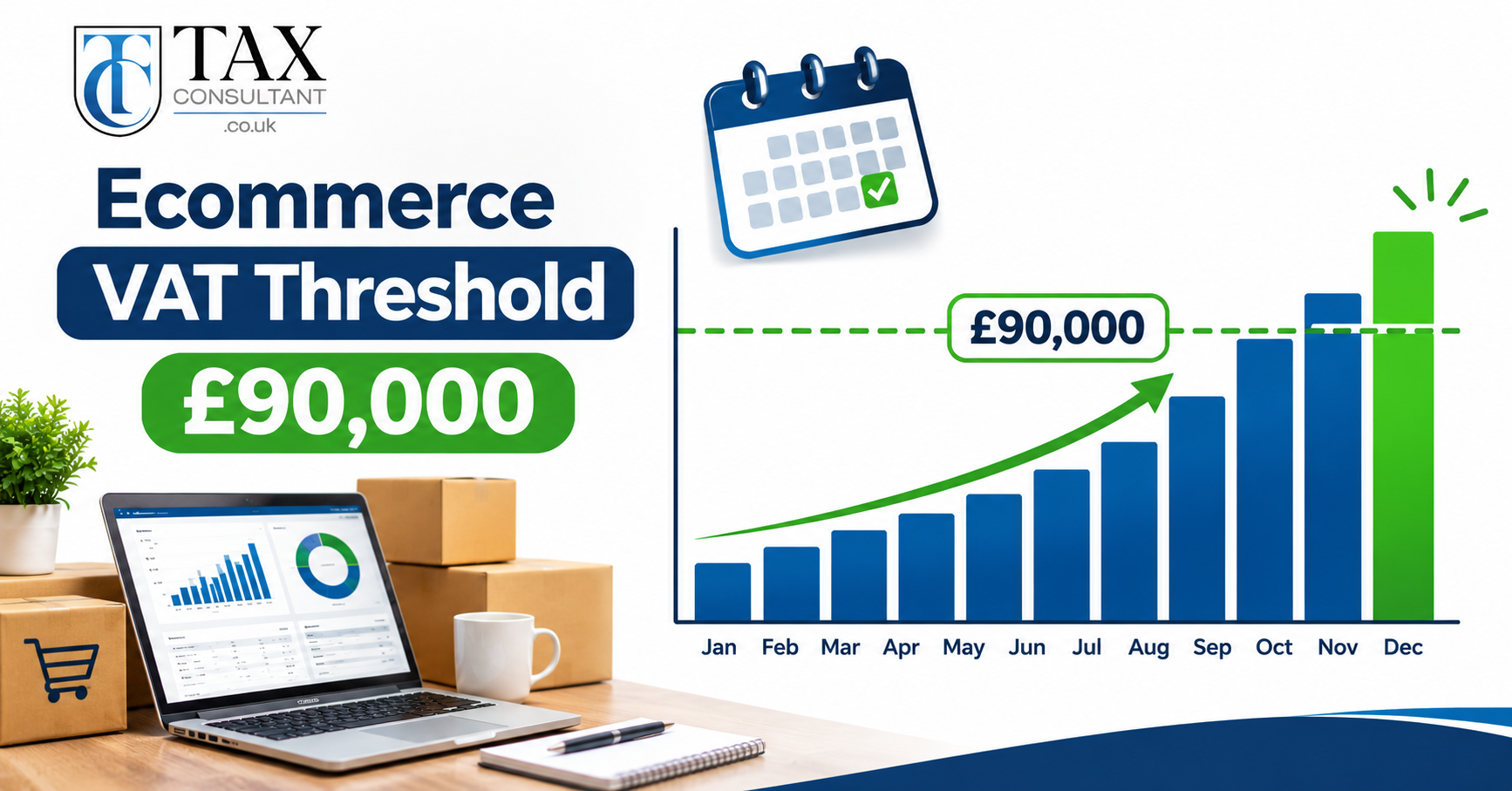
You must register for VAT when your VAT taxable turnover goes over £90,000 in any rolling 12-month period. You must also register if you expect to pass £90,000 in the next 30 days alone. HMRC sets out these limits in its VAT registration thresholds guidance.
The rolling test catches many sellers out. You check the last 12 months at the end of every month, not only at your year end. For example, a strong Black Friday and Christmas period can tip you over the limit in a single month.
You then have 30 days from the end of that month to register. You can apply through the official register for VAT service on GOV.UK. Late registration means you owe VAT on sales you already made, usually without having charged it to customers.
What Counts Towards Your Turnover
All gross sales count, across every channel, including your own website. Marketplace fees do not reduce the figure. In addition, some advertising billed by overseas companies falls under the VAT reverse charge, and those amounts can count towards the threshold too.
Should You Register Voluntarily?
Registering below £90,000 can make sense if you buy stock from VAT-registered suppliers or sell mainly to other businesses. However, it raises your prices for consumers who cannot reclaim VAT. Our VAT planning service compares both options using your real margins before you decide.
How VAT Works on Amazon, eBay and Other Marketplaces
Since 1 January 2021, online marketplaces collect UK VAT on certain sales made by overseas sellers. This “deemed supplier” rule covers imported goods worth £135 or less. It also covers goods already in the UK when an overseas seller sells them.
UK-established sellers stay responsible for their own VAT. So Amazon or eBay will not account for VAT on your behalf if your business is based in the UK. HMRC explains how marketplaces check where a seller is established in its guide to charging VAT when using an online marketplace.
Marketplaces also ask UK sellers for a valid VAT number once they register. A missing or incorrect number can lead to delays or account restrictions. Our VAT services team handles registration, returns and marketplace queries for growing online stores.
Selling to EU Customers After Brexit
Every order sent from Great Britain to an EU customer is now an export. EU consumers may face import VAT and handling charges on delivery unless you collect VAT at checkout.
The EU Import One Stop Shop (IOSS) lets you charge EU VAT at checkout on consignments worth up to €150. You then file one monthly IOSS return in a single EU country. UK sellers usually need an EU-based intermediary to join the scheme.
Storing stock in an EU warehouse changes the picture again. For example, a pan-European fulfilment programme can move your goods into Germany, Poland or France. Each country where your stock sits normally requires its own VAT registration.
Northern Ireland follows separate rules for goods. Sellers based there can use the EU One Stop Shop (OSS) through HMRC for sales to EU consumers. Every UK seller moving goods into the EU also needs an EORI number. Our guide to international VAT rules covers these cross-border points in more detail.
HMRC Now Receives Your Marketplace Sales Data
Digital platforms now report seller income directly to HMRC. These reporting rules started on 1 January 2024 and follow the OECD model rules for digital platforms.
A platform reports you once you make 30 or more sales of goods or receive about £1,700 (€2,000) in a calendar year. It sends that report to HMRC by 31 January each year. The platform also gives you a copy of the same data.
The rules create no new tax. However, HMRC can now compare platform data against your tax returns at scale. You can read HMRC’s guidance for sellers on selling goods or services on a digital platform.
If you never declared earlier sales, coming forward first usually costs less than waiting for an HMRC letter. Our voluntary disclosure service helps sellers correct past years on the best terms available.
Sole Trader or Limited Company for Online Sellers
Most new online sellers start as sole traders. Their profit goes through Self Assessment and is taxed at income tax rates, plus Class 4 National Insurance.
A limited company pays Corporation Tax on its profits instead. The rate is 19% on profits up to £50,000 and 25% on profits above £250,000, with marginal relief in between. Directors then take money out through salary and dividends.
Incorporation often suits sellers who keep profit in the business to fund stock. It also separates personal assets from product liability claims. On the other hand, it adds annual accounts, a Corporation Tax return and director duties.
A good advisor models both routes using your actual margins rather than a rule of thumb. If you trade through a company, our Corporation Tax services cover returns, payment dates and planning. Sole traders can also get help with a self assessment tax return in Manchester or anywhere else in the UK.
Making Tax Digital for Income Tax
Making Tax Digital for Income Tax now applies to sole traders with qualifying income over £50,000. It started on 6 April 2026. The threshold then drops to £30,000 from April 2027 and £20,000 from April 2028.
Qualifying income means gross income before expenses. So a seller with £60,000 in sales but only £15,000 profit still falls within scope. This catches many ecommerce sellers who run on thin margins.
Sellers in scope keep digital records and send quarterly updates through compatible software. HMRC sets out each step in its Making Tax Digital for Income Tax guidance. Your advisor can confirm whether you are in scope and set up records that pull marketplace data in automatically.
Stock, Costs and Allowable Expenses
Your taxable profit depends on how you value the stock you hold at year end. Unsold stock does not count as an expense yet. So placing a large order just before your year end does not reduce your tax bill by itself.
Common allowable costs for online sellers include the following.
- Marketplace selling fees and payment processing fees
- The cost of products and inbound shipping
- Packaging, postage and courier charges
- Advertising on marketplaces, search engines and social media
- Software subscriptions such as store platforms and repricing tools
- Refunds, returns and chargebacks
Equipment such as computers, label printers and warehouse shelving may qualify for capital allowances. A limited company can usually deduct the full cost of qualifying equipment in the year it buys it.
Very small sellers have one more option. The £1,000 trading allowance means you may not need to report trading income below that level. Once your income passes it, you need to register for Self Assessment.
Common Tax Mistakes Online Sellers Make
Most HMRC problems for online sellers come from a small number of repeat errors. Spotting them early saves penalties and interest.
- Reporting marketplace payouts instead of gross sales
- Missing the rolling VAT threshold during peak season
- Forgetting VAT registration in EU countries where stock is stored
- Claiming unsold stock as an expense
- Mixing personal and business spending on one card
Each of these mistakes is easy to fix early and expensive to fix late. That is why regular reviews matter more than a single year-end check.
Tax Advisor for Ecommerce Accountants and Bookkeepers
Complex ecommerce tax questions also reach the firms that keep sellers’ books. We act as a specialist second line for these firms on VAT, cross-border sales, incorporation and HMRC enquiries. The firm keeps its client relationship, and the seller gets a specialist answer.
This support often covers marketplace VAT reviews and VAT reclaims after late registration. It also includes help with VAT investigations and enquiries. Firms can refer a single question or a full client review.
When HMRC Opens an Enquiry
HMRC enquiries into online sellers often start from platform data or a mismatch on a VAT return. The opening letter may ask for settlement reports, stock records and bank statements covering several years.
Always reply by the deadline in the letter, and avoid sending more than HMRC requests. A tax advisor checks your figures first, manages the correspondence and agrees the scope with the HMRC officer. Our HMRC disputes team represents sellers through compliance checks, assessments and appeals.
How to Choose the Right Tax Advisor for Your Online Store
Choose someone who reads marketplace settlement reports without needing a walkthrough. Ask how they handle VAT across several channels, stock held abroad and the data platforms send to HMRC.
Next, check that their advice arrives before deadlines rather than after them. A good ecommerce tax advisor gives you a projected tax bill before your year end. That way, you can plan cash for stock and tax at the same time.
Finally, ask about fixed fees and who deals with HMRC letters. Clear answers to these questions now prevent stress later.
Frequently Asked Questions
Do I need to register for VAT if I sell on Amazon?
You need to register once your total taxable turnover passes £90,000 in a rolling 12-month period. UK-based Amazon sellers account for their own VAT. Amazon only collects UK VAT for certain overseas sellers.
Does HMRC know what I sell on eBay or Etsy?
Yes, once you make 30 or more sales or receive about £1,700 in a calendar year. Platforms report these sellers to HMRC every January.
Is ecommerce income taxed differently from shop sales?
No. The same income tax, Corporation Tax and VAT rules apply to both. The difference lies in how sales, fees and refunds are recorded across platforms.
Do I need to charge VAT to EU customers?
EU VAT applies when goods reach an EU consumer. You can collect it at checkout through IOSS on consignments up to €150, or the customer pays it on delivery.
Does Making Tax Digital apply to limited companies?
Not for income tax. MTD for Income Tax covers sole traders and landlords. However, a VAT-registered company already files its VAT returns through Making Tax Digital for VAT.
When should an online seller speak to a tax advisor?
The best time is before a change, not after it. That includes approaching the VAT threshold, storing stock abroad, incorporating or receiving a letter from HMRC.
Get Expert Tax Help for Your Online Store
Our team works as a tax advisor for ecommerce businesses across the UK, including London, Manchester, Leeds and Bristol. We advise on VAT, marketplace rules, Making Tax Digital and business structure before deadlines arrive.
Call us on 0330 133 7827, email hello@taxconsultant.co.uk or contact our team to book a consultation.