
There is no special second job tax rate in the UK. HMRC taxes your total income from every job added together, using the same bands as everyone else. What changes is how the tax is collected. You get one tax-free Personal Allowance of £12,570, and it usually goes to your main job. So your second job is often taxed from the very first pound, at 20%, 40% or 45%, depending on your total earnings.
That is why a second payslip can look so heavily taxed. In reality, you pay the same overall as someone earning the same total from a single job, as long as your tax codes are right.
This guide explains the second job tax rate in plain terms. It covers tax codes, worked examples, National Insurance, side hustles and the mistakes that lead to surprise bills.
How Is a Second Job Taxed in the UK?
Income Tax in the UK is based on your total taxable income for the tax year, which runs from 6 April to 5 April. HMRC does not care how many jobs you have. Instead, it adds everything together and applies the bands below.
| Band | Taxable income | Rate |
|---|---|---|
| Personal Allowance | Up to £12,570 | 0% |
| Basic rate | £12,571 to £50,270 | 20% |
| Higher rate | £50,271 to £125,140 | 40% |
| Additional rate | Over £125,140 | 45% |
These are the rates for England, Wales and Northern Ireland. You can check the latest figures on the GOV.UK Income Tax rates page.
The key point is that you only receive one Personal Allowance per tax year. HMRC’s guidance on more than one job confirms this applies however many jobs or pensions you have. In most cases, the allowance is attached to the job that pays you the most.
Why Your Second Job Seems to Be Taxed More
Your main job uses up the tax-free £12,570. As a result, your second employer has no allowance left to apply. Every pound from that job is therefore taxed at your marginal rate.
For example, if your main job already covers your Personal Allowance, your second job tax rate will usually be 20% on every pound. However, that is not a penalty. It simply reflects that your tax-free amount has already been used elsewhere.
In other words, more jobs does not mean more tax. Earning £35,000 from one job or from two jobs gives you the same Income Tax bill for the year.
Second Job Tax Codes Explained
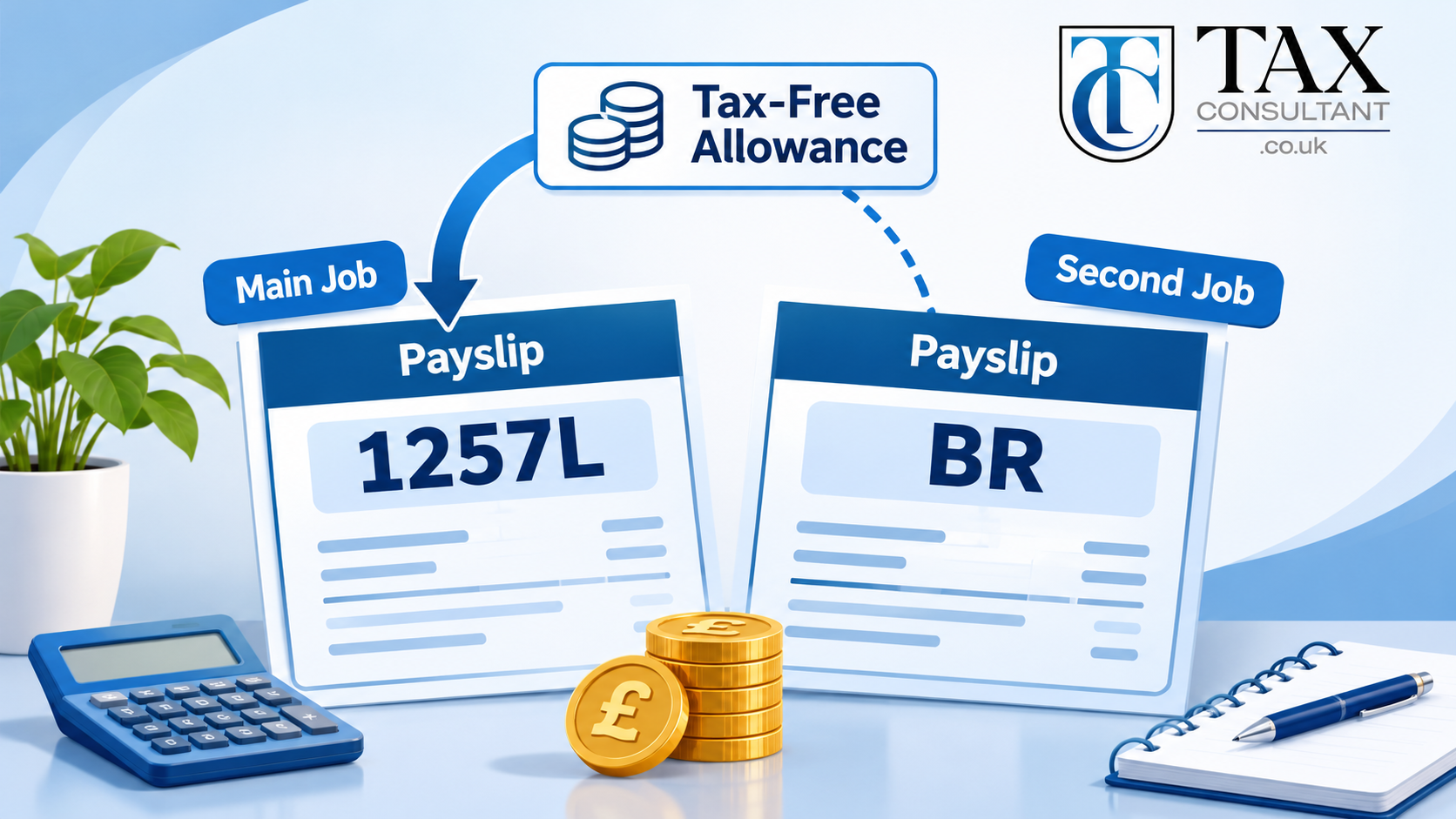
Your tax code tells each employer how much tax to deduct. If you have two jobs, you will have two tax codes. Your main job usually has 1257L, which means you get the full £12,570 allowance there.
Your second job will normally carry one of the codes below. Full details are on the GOV.UK tax codes page.
| Tax code | What it means | When it is used |
|---|---|---|
| BR | All pay taxed at 20% | Total income stays within the basic rate band |
| D0 | All pay taxed at 40% | Main job already fills the basic rate band |
| D1 | All pay taxed at 45% | Total income reaches the additional rate |
| 0T | No allowance, taxed through the bands | HMRC lacks full details, often when starting |
So the second job tax code depends on your total expected income, not on the second job alone. HMRC sets these codes using the pay figures your employers report through payroll. If you want to understand how employers report this data, our guide to PAYE reporting obligations explains the process.
If you live in Scotland, your codes start with an S, such as SBR or SD0. Scotland uses six Income Tax rates, from 19% to 48%. Welsh taxpayers have codes starting with C, although the rates currently match England. See the Scottish Income Tax page on GOV.UK for the current Scottish bands.
Worked Examples: What You Actually Pay
Numbers make this much clearer. Each example below assumes you live in England, receive the full Personal Allowance and have no other income.
Example 1: Main job £30,000 and second job £8,000
Your Personal Allowance sits on your main job. That leaves £17,430 taxable, so you pay £3,486 there. Your second job uses a BR code, so all £8,000 is taxed at 20%, which is £1,600.
Your total tax is £5,086. That is exactly what you would pay on a single £38,000 salary. Your codes are working correctly.
Example 2: Two part-time jobs paying £9,000 and £7,000
Here, neither job uses the full allowance. Your main job pays no tax and leaves £3,570 of your allowance unused. Meanwhile, if your second job is on a BR code, it deducts 20% from all £7,000, which is £1,400.
However, your correct tax is only £686. That is 20% on the £3,430 above your allowance. Without action, you would overpay £714 during the year.
The fix is to ask HMRC to split your Personal Allowance. HMRC can move the unused £3,570 to your second job, so its deductions drop to the right level.
Example 3: Main job £45,000 and second job £15,000
This is the most common trap. Your total income is £60,000, which crosses the higher rate threshold of £50,270.
Your main job uses £32,430 of the basic rate band. Therefore, only £5,270 of basic rate band remains for your second job. The other £9,730 of that job should be taxed at 40%.
The correct tax on your second job is £4,946. Yet if HMRC leaves it on a BR code, only £3,000 is deducted. That leaves a shortfall of £1,946, which you would owe after the tax year ends.
This is why a BR code does not always mean you are paying the right second job tax rate. If your combined pay passes £50,270, check your codes early.
Example 4: Employed at £28,000 with £4,000 from freelance work
Your salary is taxed through PAYE as usual. Your freelance income, however, sits outside payroll. You made £4,000 with £600 of costs, so the £1,000 trading allowance gives a better result than claiming expenses.
Your taxable profit is £3,000, taxed at 20%, which comes to £600. You pay this through Self Assessment. Because the profit is well below £12,570, no Class 4 National Insurance is due.
The £100,000 Trap for Higher Earners
Two well-paid jobs can push your total income above £100,000. At that point, your Personal Allowance shrinks by £1 for every £2 you earn above the limit. It disappears completely at £125,140.
As a result, income between £100,000 and £125,140 is taxed at an effective rate of 60%. Many people with a second job, consultancy work or board role do not realise this until a large bill arrives. Pension contributions and charitable giving can reduce adjusted net income, so tax planning is worth exploring before the year ends.
National Insurance on a Second Job
National Insurance works differently from Income Tax. It is calculated separately for each job, not on your combined pay.
For employees, Class 1 National Insurance is charged at 8% on weekly earnings between £242 and £967. Above £967 a week, the rate drops to 2%. You can confirm current rates on the GOV.UK National Insurance page.
Because each job has its own £242 threshold, two things can happen:
- If your second job pays under £242 a week, you pay no National Insurance on it, even if your total pay is high.
- If both jobs pay above £242 a week, you pay National Insurance on both.
Also, if you earn between £125 and £242 a week in a job, you pay nothing but still receive National Insurance credits. These protect your State Pension record.
High earners with several jobs may pay more than the annual maximum. In that case, you can ask HMRC to defer some contributions or refund the excess after the year ends.
What If Your Second Income Is Self-Employed?
A self-employed side income is not taxed through payroll. Freelancing, tutoring, delivery work, content creation and online selling all usually fall here.
If your gross trading income is £1,000 or less in a tax year, the trading allowance means you may not need to tell HMRC. Above £1,000, you normally need to register for Self Assessment by 5 October after the tax year ends.
Good news is on the way, too. The government has confirmed it is increasing the trading allowance to £3,000 from 6 April 2027. The Self Assessment reporting threshold will rise to the same level. More detail on both allowances is on the GOV.UK trading and property allowances page.
Your profit is added to your other income, so the same bands apply. Once your profit passes £12,570, Class 4 National Insurance applies at 6%, then 2% above £50,270. Because tax is paid after the year ends, set money aside as you earn it. If you run a side business, our support for sole traders and other clients can help you stay on track.
Emergency Tax on a Second Job
When you start a second job, you will not have a P45, because you still work for your first employer. Instead, you fill in the HMRC starter checklist and give it to your new employer.
Answer it carefully. You should tick the box saying you have another job. If you get this wrong, your new employer may apply an emergency tax code such as 0T, 1257L W1 or 1257L M1.
The problem is that an emergency code can give you the Personal Allowance twice, leading to an underpayment. Alternatively, it can tax you too heavily at first. Either way, HMRC usually corrects the code once it receives full details from both employers.
Can You Split Your Personal Allowance?
Yes, in the right circumstances. Splitting makes sense when your main job pays less than £12,570, as in Example 2. HMRC can then move the unused part to your second job.
You can ask by contacting HMRC about Income Tax or updating your details online. However, splitting works best when your pay is steady. If your hours vary and one job pays more than expected, you could underpay and owe tax later.
How to Check You Are Paying the Right Amount
The easiest way to stay on top of your second job tax rate is to check your details during the year. Your Personal Tax Account and the HMRC app let you see both tax codes, which job uses your allowance, and HMRC’s estimate of your total income.
Use this quick checklist:
- Your main job shows 1257L, or the code in your latest HMRC notice.
- Your second job shows BR, D0 or D1, matching your total expected income.
- HMRC’s estimate of your income for each job looks realistic.
- Any job you have left is marked as ended.
- If your total pay is above £50,270, your second job is not still on a plain BR code.
After the tax year ends, HMRC reviews what you paid. If the figures do not match, you will receive a P800 tax calculation. This shows whether you are due a refund or owe extra tax. Underpayments are often collected through your tax code the following year.
If your tax position has gone wrong across several years, our individual compliance review can identify the problem. Where income was never reported, voluntary disclosure is usually the safest way to put things right with HMRC.
Other Things a Second Job Can Affect
A second job can affect more than Income Tax. Keep these points in mind.
Student loans. Each employer only looks at the pay it gives you. So you could earn above the repayment threshold overall without either job deducting repayments. If you file a Self Assessment return, the balance may be collected then.
Pensions. If you receive a pension and also work, your Personal Allowance may sit on the pension. Your job could then be on a BR code. Our pensions tax support covers this situation.
Benefits. Extra earnings can reduce means-tested benefits such as Universal Credit. Check the rules before you take on more hours.
Workplace pensions. Your second employer may enrol you in another pension scheme. Keep track of small pots so none get lost.
When to Get Professional Tax Advice

Most people with two simple PAYE jobs can manage on their own. However, it pays to speak with a tax advisor if:
- your combined income is above £50,270 or close to £100,000
- you mix employment with self-employed or rental income
- you have received a P800 showing a large underpayment
- you have paid the wrong amount over several tax years
Our team works with clients across the UK from our offices in London, Manchester, Leeds and Bristol. If your employer wants help getting payroll codes right, our employment taxes service covers that too.
Contact our tax advisors today or call 0330 133 7827. We will check your tax codes, confirm your second job tax rate and make sure you pay only what you owe.
Frequently Asked Questions
What is the second job tax rate in the UK?
There is no separate rate. Your second job is taxed at 20%, 40% or 45%, depending on your total income. Because your Personal Allowance usually sits on your main job, the second job is often taxed from the first pound.
Why is my second job on a BR tax code?
BR means all your pay from that job is taxed at 20%. HMRC uses it when your Personal Allowance is already used by your main job and your total income stays within the basic rate band.
Do I pay more tax with two jobs than with one?
No. Your total Income Tax is the same as if one job paid the combined amount. However, National Insurance can differ, because it is worked out separately for each job.
Do I pay National Insurance on both jobs?
Only if each job pays more than £242 a week. Each employer applies its own threshold, so a second job below that level pays no National Insurance.
Do I need to file a tax return for a second job?
Usually not, if both jobs are taxed through PAYE. You may need one if you have self-employed income over £1,000, rental income or certain other untaxed income.
What happens if I underpay tax on my second job?
HMRC will send you a P800 tax calculation after the tax year ends. The amount owed is often collected through your tax code the next year, or you can pay it directly.
Can HMRC split my Personal Allowance between two jobs?
Yes. If your main job pays less than £12,570, HMRC can move the unused allowance to your second job. This works best when your pay from both jobs is stable.