Tax advice UK services range from free HMRC helplines to specialist tax advisors who plan, file and defend your tax affairs. The right choice depends on how complex your income is, how much tax is at stake and whether HMRC has already been in touch.
This guide explains every option in plain English. You will learn when free help is enough, when to pay for an expert, and how to spot an advisor you can trust.
Key points
- Most employees on PAYE with one simple income do not need paid advice.
- Free help exists through HMRC and tax charities, mainly for people on low incomes.
- Landlords, the self-employed, company directors and high earners usually save more than the advisor’s fee.
- “Tax advisor” is not a protected title in the UK, so always check professional membership.
- Get help fast if HMRC opens a compliance check or sends an information notice.
In this guide
- What tax advice actually covers
- Do you need a tax advisor?
- Free tax advice options in the UK
- Paid professional tax advice
- Types of tax advisor compared
- How much tax advice costs
- How to choose a tax advisor you can trust
- What to prepare before your first meeting
- Tax advice for businesses
- Frequently asked questions
What Tax Advice Actually Covers
Tax advice is guidance on how UK tax rules apply to your income, gains, property and business. It can be a one-off answer, an ongoing service or full representation in front of HMRC.
Good advice usually falls into three areas:
- Compliance. Filing returns correctly and on time, such as Self Assessment, VAT and Corporation Tax.
- Planning. Using legal allowances and reliefs to reduce what you owe before the tax year ends.
- Disputes. Handling HMRC enquiries, appeals and disclosures when something goes wrong.
Each area needs a different skill set. A bookkeeper may file a simple return well, but a disputed tax bill often needs a specialist who handles HMRC investigations every week.
Do You Need a Tax Advisor?

Many people pay too much tax simply because nobody told them about a relief. Others pay for advice they never needed. The test is simple: how many moving parts does your income have?
You probably do not need paid advice if:
- you earn a salary through PAYE and have no other income
- your tax code looks right in your HMRC Personal Tax Account
- you have no rental income, investments outside an ISA or side business
You probably do need advice if:
- you are self-employed, a landlord or a company director
- you earn over £100,000, where your tax-free Personal Allowance starts to shrink
- you are selling property, shares or a business
- you have income from abroad or plan to move overseas
- you are planning gifts or your estate for your family
- you have received a letter from HMRC you do not understand
A good rule of thumb is that the more decisions you make about your money, the more value advice adds. Timing matters too. Advice given before 5 April, the end of the tax year, can save far more than advice given after the deadline.
Free Tax Advice Options in the UK

Free help is real and useful, but it has limits. It is designed for simple questions or for people who cannot afford a professional.
HMRC helplines and online services
For straightforward queries, start with HMRC itself. You can check your tax code, claim refunds and view your Income Tax estimate online. The government’s get help with tax page lists every contact route.
HMRC is also the first place to go if you cannot pay your tax bill on time. Early contact often leads to a payment plan rather than penalties.
Keep in mind that HMRC tells you what the rules are. It does not tell you how to pay less tax.
Tax charities
Two charities offer free professional tax help to people on low incomes:
- TaxAid helps with personal and small business tax problems, mainly for people on lower incomes.
- Tax Help for Older People supports people over 60 with personal tax questions.
Both have income limits, and neither handles tax planning or company tax.
Friends and family as trusted helpers
You can authorise a family member or friend to deal with HMRC for you as a “trusted helper”. This works well for an older relative who needs help with forms, but it is not professional advice.
| Free help | Best for | Main limit |
|---|---|---|
| HMRC | Tax codes, refunds, payment plans | No planning advice |
| Tax charities | Low-income households, older people | Strict income limits |
| Trusted helper | Help with forms and calls | No expert knowledge |
Paid Professional Tax Advice
Paid advice makes sense when the tax at stake is larger than the fee. A specialist looks at your full picture, not just one form.
A professional tax advisor can:
- prepare and file your Self Assessment tax return online and check every claim
- build a tax planning strategy around pensions, gifts and business structure
- advise on trusts and Inheritance Tax so more of your estate reaches your family
- handle residence, domicile and double tax relief if you earn or live abroad
- speak to HMRC on your behalf once you authorise them as your agent
That last point matters more than people expect. Once your advisor is authorised, HMRC letters and calls go through them. That removes much of the stress and cuts the risk of saying the wrong thing.
Types of Tax Advisor Compared
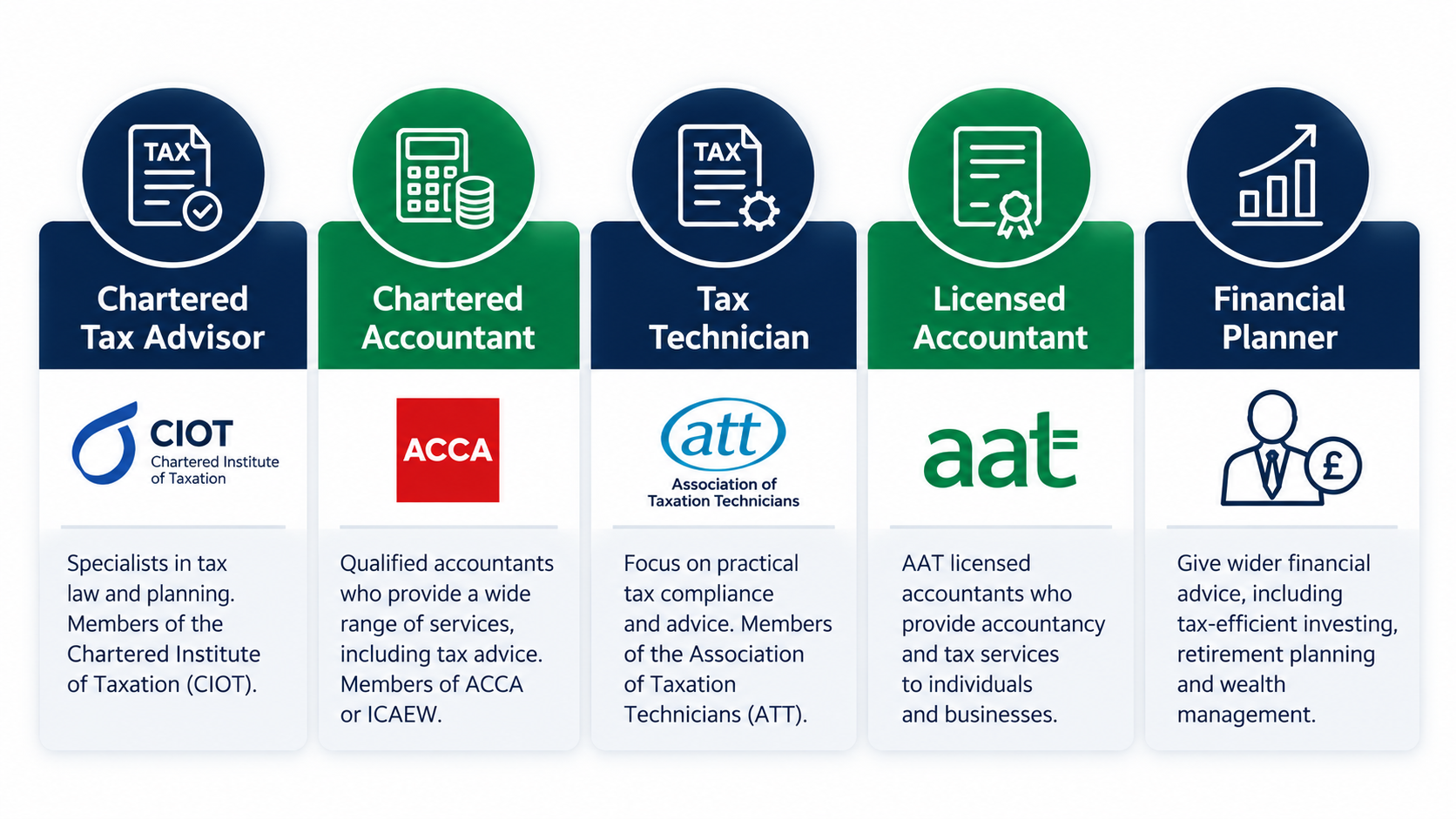
Not every professional offers the same service. The UK has several qualifications, and each one signals a different depth of training.
| Advisor type | Typical qualification | Best for |
|---|---|---|
| Chartered Tax Advisor | CTA (Chartered Institute of Taxation) | Complex planning, disputes, high-value cases |
| Chartered accountant | ACA (ICAEW) or ACCA | Business accounts plus tax |
| Tax technician | ATT | Returns and everyday compliance |
| Licensed accountant | AAT | Small business bookkeeping and returns |
| Financial planner | Regulated by the FCA | Pensions and investments with tax in mind |
Many firms combine these skills in one team. A practice may use AAT-qualified staff for bookkeeping and refer complex issues to a CTA. Ask who will actually handle your file.
How Much Tax Advice Costs
Fees depend on complexity, not just time. Most UK firms use one of three models:
- Fixed fee. Common for Self Assessment returns, VAT returns and annual accounts. You know the price up front.
- Monthly package. Popular with limited companies that need bookkeeping, payroll and tax under one plan.
- Hourly or project rate. Used for one-off planning, property sales and HMRC enquiries.
At Tax Consultant, Self Assessment returns start from £249. For planning or HMRC work, ask for a written quote that shows exactly what is included.
The cheapest option is rarely the best value. One missed relief or penalty can cost far more than the difference in fees.
How to Choose a Tax Advisor You Can Trust
Anyone in the UK can call themselves a tax advisor, so you need to check credentials yourself. Use this checklist before you sign anything.
- Check membership. Look for CIOT, ATT, ICAEW, ACCA or AAT, and confirm it on the body’s own website.
- Ask about insurance. A professional advisor should hold professional indemnity insurance.
- Get an engagement letter. It should list the services, fees and who does the work.
- Ask about experience. Someone who handles landlords every day will spot reliefs a generalist may miss.
- Watch for red flags. Be wary of anyone promising to cut your tax to almost nothing, or selling a “scheme” that sounds too good to be true.
Members of the main professional bodies follow shared standards on tax conduct. That gives you protection if something goes wrong.
What to Prepare Before Your First Meeting
A prepared first meeting saves time and money. Bring or send the following:
- your Unique Taxpayer Reference (UTR) and National Insurance number
- your last two tax returns, if you filed any
- P60s, P45s or payslips from employment
- records of self-employed income and expenses
- rental statements, mortgage interest and letting agent fees
- details of shares, property or crypto you have sold
- any letters from HMRC, including envelopes and dates
Write down your questions too. Clear goals, such as “I want to reduce tax on my rental income”, help your advisor focus on what matters to you.
Tax Advice for Businesses
Business owners face more taxes, more deadlines and more chances to make costly mistakes. Specialist tax advice UK firms provide often pays for itself in the first year.
Limited companies
Directors need to balance salary, dividends and pension contributions. An advisor can also explain current Corporation Tax rates and reliefs such as capital allowances on equipment.
VAT
VAT rules change by sector and can catch out growing businesses. Expert VAT advisory services cover registration, partial exemption and reclaims.
Payroll and employment taxes
Hiring staff brings PAYE, pensions and benefits in kind. Outsourced payroll services keep you compliant and free up your time.
Making Tax Digital for Income Tax
Sole traders and landlords now face digital record keeping and quarterly updates once their qualifying income passes HMRC’s threshold. The threshold falls in stages, reaching £20,000 from April 2028, which brings many more small landlords and sole traders into scope. Read HMRC’s Making Tax Digital for Income Tax guidance and speak to an advisor early about software and record keeping.
When HMRC Gets in Touch

An HMRC letter is the moment most people realise they need expert help. Do not ignore it, and do not reply in a panic.
Common situations include:
- a compliance check into your return
- a request for documents under an information notice
- a discovery assessment for an earlier year
- a penalty you believe is unfair
An experienced advisor can manage the whole process, from the first reply to a formal tax appeal. If you know past returns were wrong, a voluntary disclosure usually leads to lower penalties than waiting for HMRC to find the error. Our team also carries out an individual compliance review to check your position before HMRC does.
Frequently Asked Questions
Is tax advice free in the UK?
Some is. HMRC answers general questions, and tax charities help people on low incomes. Tax planning and representation in disputes usually come from paid professionals.
What is the difference between a tax advisor and an accountant?
An accountant prepares accounts and often files returns. A tax advisor specialises in tax law, planning and disputes. Many professionals do both.
Can a tax advisor speak to HMRC for me?
Yes. Once you authorise them as your agent, they can deal with HMRC directly about your tax affairs.
When should I get tax advice?
Get advice before a big decision, such as selling property, starting a business or making large gifts. Advice before the tax year ends on 5 April gives you the most options.
Is tax planning legal?
Yes. Using allowances, pension contributions and reliefs the law provides is legal tax planning. Aggressive avoidance schemes are a different matter and can lead to large bills and penalties.
Do I need tax advice if I am employed?
Usually not, if your only income is a salary taxed through PAYE. Check your tax code each year, and get advice if you add rental, self-employed or investment income.
What if I have missed a Self Assessment deadline?
File as soon as possible, because penalties grow over time. An advisor can file the late return and check whether you have grounds to appeal the penalty. HMRC’s Self Assessment guidance explains the deadlines.
Get Expert Tax Advice From Tax Consultant
Tax Consultant supports individuals, landlords, sole traders and limited companies across the UK, with offices in Leeds, Manchester, London and Bristol. Our team handles everything from simple returns to complex planning and HMRC investigations.
See who we help or find your nearest office. To talk through your situation, call 0330 133 7827, email hello@taxconsultant.co.uk or contact our team today.
This article gives general information, not personal advice. Tax rules and rates change, so check the latest figures on GOV.UK income tax rates or speak to a qualified advisor before acting.