
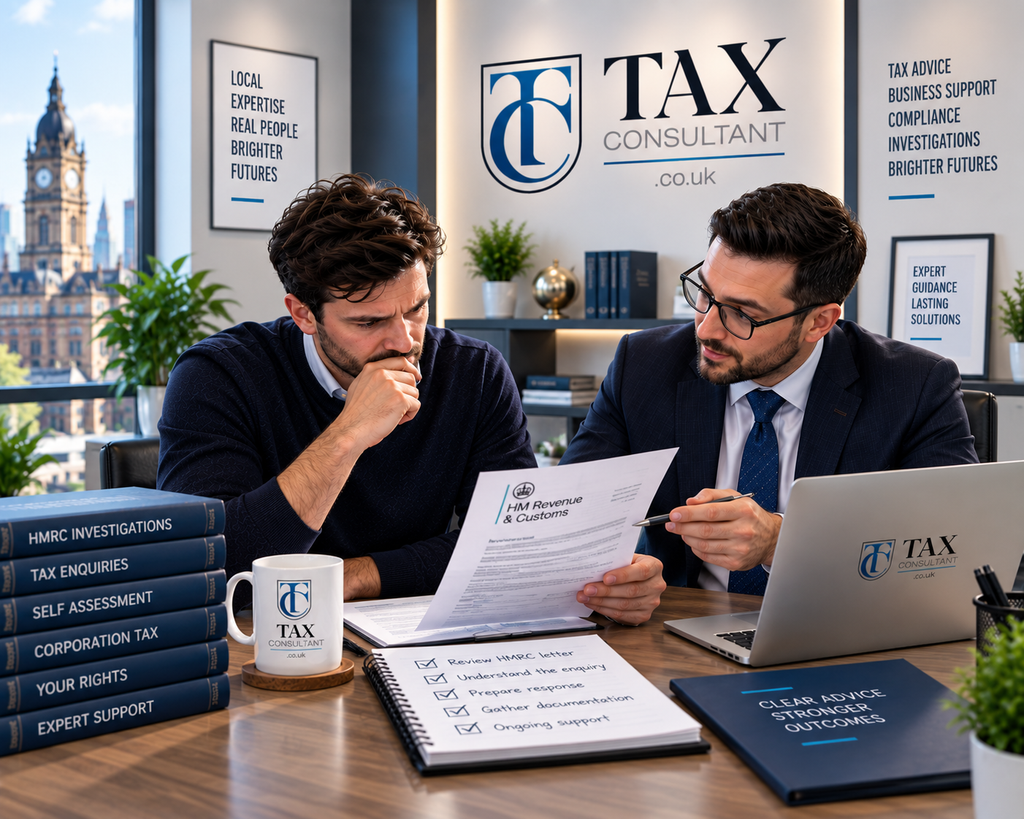
Receiving a letter from HMRC saying your tax affairs are being looked at is enough to worry anyone. Whether you’re a sole trader in Leeds city centre, a landlord in Headingley or a company director in Horsforth, an HMRC enquiry can feel stressful, time-consuming and confusing.
The good news is that you don’t have to deal with it alone. Professional tax investigation services in Leeds can take the pressure off, handle HMRC on your behalf and help you reach the best possible outcome. In this guide, we explain why HMRC opens investigations, the different types of enquiry, what happens during the process and how a specialist can protect you. If you need help right now, speak to our HMRC tax investigation specialists today.
What Is an HMRC Tax Investigation?
An HMRC tax investigation, often called a tax enquiry or compliance check, is when HMRC reviews your tax return, accounts or records to make sure you’ve paid the right amount of tax. It doesn’t automatically mean you’ve done anything wrong. Many investigations are routine, and some are chosen completely at random.
HMRC can look at almost any tax, including:
- Self Assessment tax returns
- Corporation tax returns for limited companies
- VAT returns and VAT inspections
- PAYE and employer records
- Capital gains tax on property and investment sales
- Inheritance tax on estates
Whatever the tax, an experienced tax investigation advisor in Leeds can guide you through every stage.
Why Does HMRC Open Tax Investigations?
HMRC uses powerful data tools to spot returns that look unusual. Common triggers include:
- Income that looks low compared with similar businesses in your sector
- Large or unusual expense claims
- Big changes in profit from one year to the next
- Late or missing tax returns
- Undeclared rental income or property sales
- Information from banks, letting agents, online platforms or other third parties
- Tip-offs from members of the public
- Mistakes or inconsistencies across different returns
HMRC also sends “nudge letters” to people it believes may have undeclared income, such as overseas income or earnings from online selling. These letters need a careful response, and it’s worth getting advice before you reply.
Types of HMRC Tax Investigation
Not all investigations are the same. Understanding which type you’re facing helps you respond in the right way.
Aspect Enquiry
An aspect enquiry focuses on one specific part of your tax return, such as a particular expense claim or source of income. These are the most common type and are often resolved quickly if you have good records.
Full Enquiry
A full enquiry looks at your entire tax return and the records behind it. HMRC may ask for bank statements, invoices, receipts and business records. These can take months to resolve without professional support.
Random Enquiry
Some returns are selected at random to check overall compliance. Even though there’s no suspicion of wrongdoing, a random enquiry still needs a careful, accurate response.
VAT and Employer Compliance Checks
HMRC may visit your business or ask for records to check your VAT returns or PAYE. This can include questions about how you treat workers, including employment status and IR35 for contractors.
COP8 and COP9 Investigations
These are HMRC’s most serious civil investigations. COP8 is used where HMRC suspects significant tax avoidance or complex issues. COP9 is used where HMRC suspects serious tax fraud, and it offers the Contractual Disclosure Facility. If you receive either, you should get specialist tax investigation advice in Leeds immediately.
How Far Back Can HMRC Investigate?
HMRC can usually open an enquiry into a Self Assessment return within 12 months of the date it was filed, as long as it was filed on time. However, HMRC can look back much further if it believes tax has been underpaid:
- Up to 4 years for genuine mistakes
- Up to 6 years where the underpayment was caused by carelessness
- Up to 20 years where the underpayment was deliberate
This is why keeping good records, and fixing errors early, matters so much.
What Happens During an HMRC Investigation?
Every case is different, but most investigations follow a similar pattern.
1. HMRC Opens the Enquiry
You or your accountant will receive a letter explaining which tax and period HMRC is looking at, and what information it needs.
2. Information and Document Requests
HMRC will ask for records, explanations or a meeting. There will be a deadline to respond, and missing it can lead to penalties.
3. HMRC Reviews the Evidence
HMRC examines your records and may ask follow-up questions. This stage can take weeks or months.
4. Outcome and Settlement
HMRC will either close the enquiry with no changes or tell you it believes more tax is due. If extra tax is owed, there may also be interest and penalties. You have the right to disagree, ask for an independent review or appeal to a tax tribunal, usually within 30 days of HMRC’s decision.
HMRC Penalties: What Could You Face?
If HMRC finds you’ve underpaid tax, penalties depend on why the error happened and how you behaved during the investigation. For errors in tax returns, penalties can be:
- Up to 30% of the extra tax for careless errors
- Up to 70% for deliberate errors
- Up to 100% for deliberate errors that were concealed
Penalties can be reduced significantly, sometimes to zero for careless errors, if you tell HMRC about the problem yourself and cooperate fully. This is where expert tax investigation services make a real difference. Making a voluntary disclosure before HMRC contacts you almost always leads to a better result.
Why Use a Tax Investigation Specialist in Leeds?
It’s tempting to deal with HMRC yourself, but saying the wrong thing or sending incomplete information can make things worse. A specialist tax investigation advisor in Leeds will:
- Deal with HMRC directly on your behalf, so you don’t have to
- Review your records and spot problems before HMRC does
- Check that HMRC’s requests are reasonable and within its powers
- Prepare clear, accurate responses on time
- Negotiate the lowest possible penalties
- Make voluntary disclosures where needed
- Represent you in meetings, reviews and appeals
Most importantly, you get peace of mind knowing an expert is protecting your interests. If you’re not sure how to pick the right professional, read our guide on how to choose a tax advisor in Leeds.
What to Do If You Receive a Letter from HMRC
If an HMRC letter lands on your doormat, follow these steps:
- Don’t ignore it. Missing deadlines can lead to penalties and make HMRC less flexible.
- Don’t panic. Many enquiries close with little or no extra tax to pay.
- Don’t reply straight away without advice, especially to nudge letters or COP8 or COP9 letters.
- Gather your records, including bank statements, invoices, receipts and previous returns.
- Speak to a tax investigation specialist as early as possible.
For more detail, see our step-by-step guide on what to do if you get a letter from HMRC.
Tax Investigation Help for Landlords and Businesses in Leeds
HMRC has been paying close attention to landlords and small businesses in recent years. Leeds has a large rental market, from student lets in Headingley and Hyde Park to family homes in Roundhay and Garforth, and HMRC receives data directly from letting agents and deposit schemes.
If you have undeclared rental income or you’ve sold a property without reporting it, our landlord tax services can help you put things right before HMRC gets in touch. Our tax guide for Leeds landlords also explains the rules you need to follow.
Expert Tax Investigation Services in Leeds
At Tax Consultant, we help individuals, landlords, freelancers and limited companies across Leeds and West Yorkshire deal with HMRC enquiries calmly and confidently. From simple aspect enquiries to complex COP8 and COP9 cases, our team handles everything, including voluntary disclosures, penalty negotiations and appeals.
We work with clients throughout Leeds, including Headingley, Horsforth, Roundhay, Chapel Allerton, Morley, Pudsey and Wetherby. Find out more about our tax investigation services, speak to an experienced tax advisor in Leeds or book your free, confidential consultation today.

Frequently Asked Questions About Tax Investigations in Leeds
How long does an HMRC tax investigation take?
Simple aspect enquiries can be resolved in a few weeks, while full enquiries and complex cases can take many months or longer. Responding quickly and accurately, with professional support, usually speeds things up.
Does an HMRC investigation mean I’ve done something wrong?
Not necessarily. Many investigations are routine checks or random selections. However, every enquiry should be taken seriously and handled carefully.
Can a tax advisor deal with HMRC for me?
Yes. Once you authorise them as your agent, a tax advisor can speak to HMRC for you, handle all letters and requests, and represent you in meetings and appeals.
Can I reduce HMRC penalties?
Yes. Penalties can often be reduced significantly by telling HMRC about errors yourself, cooperating fully and giving HMRC full access to your records. A specialist can negotiate on your behalf.
What should I do if I’ve made a mistake on a past tax return?
Get advice as soon as possible. Making a voluntary disclosure before HMRC finds the error usually results in much lower penalties than waiting to be caught.
How much do tax investigation services in Leeds cost?
It depends on the type and complexity of the investigation. Some businesses have tax investigation fee protection insurance that covers professional fees. Contact us for a clear quote. You can also see our fees.