
Your R&D claim is one of the most valuable reliefs available to a UK limited company and one of the most scrutinised. On 18 May 2026, HMRC launched a brand new targeted advance assurance pilot giving eligible SMEs the chance to get HMRC’s written view on particular high-risk areas of a claim before they file.
If you have been putting off an R&D claim due to uncertainty, or if you have had a claim challenged before, the HMRC R&D Advance Assurance SME 2026 pilot may be just the tool you have been waiting for. The window remains open until May 2027.
What Is the 2026 Targeted Advance Assurance Pilot?
The existing R&D advance assurance service has been in place since 2015, but has always been limited to first-time claimants with a turnover of under £ 2 million and fewer than 50 employees. Most SMEs were never eligible. In 2023/24, uptake was less than 1% of eligible firms.
HMRC listened. The new targeted pilot, launched 18 May 2026, is a different service entirely. Any SME carrying out R&D or planning to can apply, regardless of whether they have claimed before. You ask HMRC to confirm its view on up to two specific complex or high-risk areas of your claim, before you submit your corporation tax return. HMRC aims to respond within 40 calendar days.
This is not a full-claim review. The pilot is deliberately focused on the areas where disputes happen most.
HMRC R&D Advance Assurance SME Apply 2026 Who Qualifies?
The eligibility rules are set out in HMRC’s official guidance published on GOV. UKUK on 18 May 2026. Your company must:
- Meet the SME definition under the corporation tax R&D rules
- Be carrying out R&D in the accounting period you are requesting assurance for, or be planning to do so
- Not yet have claimed R&D tax relief for that period
- Not already have received assurance on the same two areas for the same period
The pilot is not available to large companies. It is also not available where your company, or any connected person, has entered into a disclosable Tax Avoidance Scheme under DOTAS, been categorised as a Corporate Serious Defaulter, or has an open enquiry into a corporation tax return.

Which Areas Can You Ask HMRC to Review?
This is where the pilot becomes genuinely useful. You can request assurance on any one of the following four areas per application:
Whether your project meets the definition of R&D for tax purposes. This is the most common area of dispute.
Whether overseas expenditure qualifies. Since the merged RDEC rules introduced in April 2024, overseas subcontractor and externally provided worker costs are only allowable in limited circumstances. If your project involves overseas development, testing, or contracted research, this area is a live risk.
Whether contracted-out R&D qualifies. This is the most contested area of the merged regime. Where one company contracts R&D out to another, the rules on who can claim and on what are complex, and the HMRC guidance has shifted repeatedly. Getting a written HMRC view on your specific contracting arrangement before you file is extremely valuable.
Whether you qualify for exemption from the PAYE and NIC cap. The cap limits relief for some companies, but exemptions exist. If you believe your company qualifies for an exemption, the pilot gives you a route to confirm this upfront.
You can make up to two separate applications, one per project, one area per application. Each application must cover a single project and a single area.
What You Will Need Before You Apply
HMRC will not accept incomplete applications. Before you open the online form, which cannot be saved midway, have the following ready:
- The project start date
- Contact details for the competent professional overseeing the R&D work, and a senior officer of the company
- A clear project overview, accounting period start date, forecasted expenditure, and project duration
- Records of the type of documentation your company is keeping
- If overseas expenditure is one of your areas, written justification for why you believe it qualifies
Your tax adviser or agent can submit the application on your behalf, provided they hold the appropriate HMRC authorisation form 64-8 for a standard agent relationship, or form COMP1 if HMRC is dealing with your adviser directly in connection with a compliance check.
The Risk You Need to Understand
The advance assurance pilot is voluntary. You do not have to use it. It is reason to make a good, detailed application. A good application with clear documentation of the project, by a credible and competent professional, is much less likely to be turned down than a vague application. If you have your bookkeeping and project records on Xero, Sage or QuickBooks, your adviser can extract the right financial data cleanly for the application. Poor records are the most common reason advance assurance applications fail.
If HMRC grants assurance, they will issue a written confirmation. That assurance is valid for the accounting period it covers. You still need to submit the claim through your corporation tax return in the usual way; the assurance does not file the claim for you.
Why the HMRC R&D Advance Assurance SME Apply 2026 Pilot Matters Right Now
HMRC has been looking closely at R&D claims since 2023. HMRC compliance checks on R&D claims doubled in the 2023/24 tax year, and the introduction of the Additional Information Form, which has been required since August 2023, means every claim now comes with significantly more detail for HMRC to interrogate.
The launch of the R&D overclaims disclosure facility in January 2025 shows the seriousness with which HMRC is treating historical errors. Businesses that overclaimed through third-party agents are being actively pursued. Tribunal cases are rising. Getting your claim right the first time has never mattered more.
The targeted pilot is a direct response to all of this. HMRC is seeking to reduce error and dispute at the front end, not the back end. That’s really good news for legitimate claimants wanting certainty. Construction businesses claiming on innovative materials or methods, healthcare companies developing new diagnostic tools, software developers working through genuine technological uncertainty all of these are areas where the pilot could provide real confidence before a claim is filed.
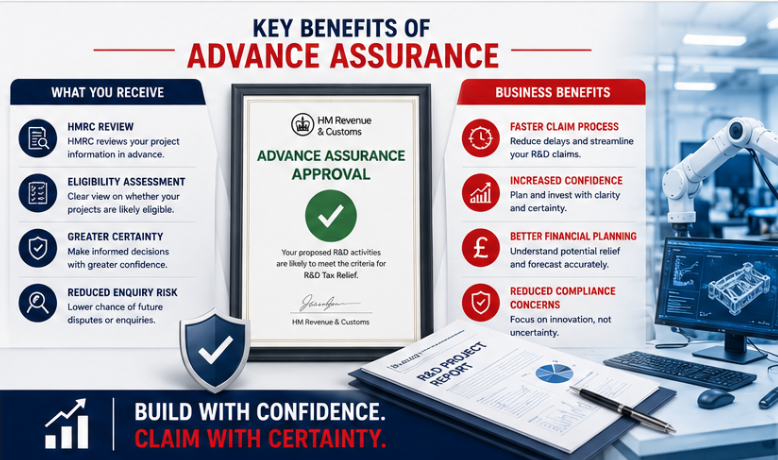
The Contracted-Out Question and Why It Demands a Clear Answer Before You File
If your company commissions another business to carry out R&D on your behalf or if you perform R&D under contract for a client, the merged RDEC rules introduced in April 2024 changed the landscape significantly. Before the merged regime, the rules on contracted-out R&D were reasonably settled. The new rules under CIRD160000 have created genuine uncertainty about which party in a contracting arrangement can claim, and on what expenditure.
HMRC named contracted-out R&D as one of the four areas specifically available under the pilot for exactly this reason. The rules are contested. The guidance has shifted. And the financial stakes: R&D relief on a meaningful contract can run into tens of thousands of pounds, making getting the wrong answer expensive.
If your business contracts out any element of its R&D activity, or performs contracted R&D for third parties, applying for advance assurance on this area before your next corporation tax return is one of the most defensible steps your tax planning can include.
The Full Claim Service Is Still Available for First-Time Claimants
The targeted pilot sits alongside the existing full claim advance assurance service, which is still open. That service is only for SMEs making their first R&D claim, with turnover below £2 million and fewer than 50 employees. Under that service, HMRC reviews the entire claim, and any agreement covers your first three accounting periods.
The two services cannot be used for the same accounting period at the same time. If you are a first-time claimant who meets the existing service’s eligibility criteria, speak to your adviser about which route better suits your situation. The targeted pilot is more accessible but narrower. The full claim service is broader in scope but tightly restricted by eligibility.
HMRC R&D Advance Assurance SME Apply 2026: What Happens After You Apply
If you have provided full and accurate information, HMRC will aim to deal with your application within 40 calendar days. They may contact you with questions within that time period.
If assurance is given, HMRC will confirm in writing. That confirmation provides you with a good foundation on which to file your claim, knowing that the specific area you asked about has been reviewed and accepted.
Either outcome gives you better information than filing blind. And in a compliance environment where R&D investigations are rising, more information before the claim lands is always more useful than less.
Work With a Team That Knows R&D Claims Inside Out
The targeted advance assurance pilot is a genuine opportunity, but only if your application is built properly. A vague project description, incomplete cost documentation, or a poorly articulated competent professional statement will slow the process or result in refusal.
At Tax Consultant UK, our R&D tax relief team works with limited companies, healthcare businesses, and construction clients across West Yorkshire, Leeds, London, Manchester, and Bristol to build claims that stand up to scrutiny. We handle the advance assurance application alongside your wider tax planning and corporation tax position, so nothing is filed in isolation.
If HMRC opens a compliance check on an R&D claim, whether before or after you use this pilot, our HMRC investigations team handles the response. We know what HMRC looks for. We know what documentation survives scrutiny. And we know how to prepare an advance assurance application that gives you the best chance of a clean, written HMRC agreement before your claim is filed.
The HMRC R&D advance assurance SME Apply 2026 pilot closes in May 2027. That is less than twelve months away.
Contact Tax Consultant UK now to find out whether your business qualifies for the pilot and how we can help you build the strongest possible application. Reach our team at taxconsultant.co.uk/get-in-touch or call 0330 133 7827.